

Today, the United States operates more nuclear reactors than any other country on Earth.
Most people probably don’t realize this fact, but what’s even more intriguing to us is the fact that we can barely feed these reactors.
The truth is, domestic mines in the U.S. only produce somewhere around 3% to 4% of the uranium that our reactors burn through in a year.
The rest comes from somewhere else, which gives us a scary dependence on foreign sources for nuclear fuel.
However, this isn’t the real horror story.
You see, when you get down to the actual enriched fuel (you know, the stuff that gets loaded into a reactor core)… well, the picture gets much worse.
It turns out that we import nearly 99% of it.
Let that sink in for a second.
We’re talking about the country that built the bomb, and pioneered civilian nuclear power.
Of course, we’re also the guys that run the largest fleet of reactors on the planet, and we heavily rely on foreign suppliers for almost every pound of fuel that keeps the lights on.
By the way, this isn’t exactly a new problem.
This has been an ongoing issue that’s been building for twenty years.
A major turning point took place in 2013. That’s when America’s last U.S.-owned, commercial-scale uranium enrichment facility was shut for good. This aging relic from the Cold War simply couldn’t compete anymore, especially as cheap enrichment services from Russia (ironically enabled by a U.S.-Russia agreement meant to keep former Soviet warheads out of the wrong hands) had already gutted the economics of doing it here.
Unfortunately, we’ve spent the years since paying someone else to do it for us.
You can bet that’s about to change, and President Trump is now looking to roughly quadruple U.S. nuclear capacity by mid-century, just as an AI-driven surge in electricity demand makes reactors more valuable than they’ve been in decades.
Of course, all of this is taking place while we STILL rely on a small handful of foreign suppliers for the fuel to run them.
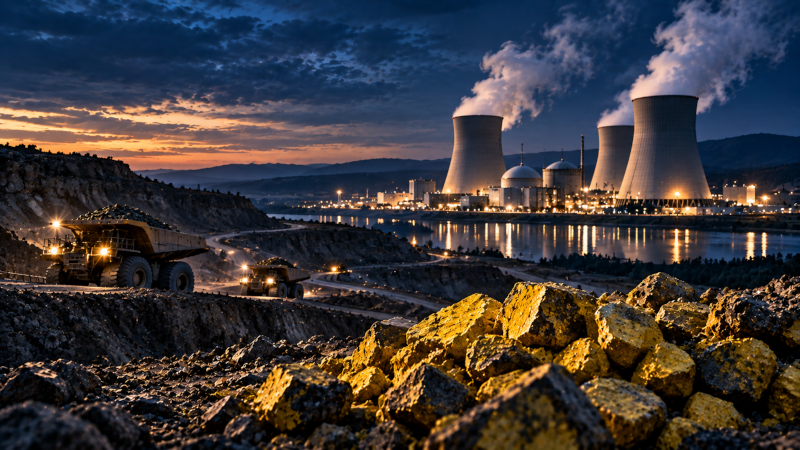
So how exactly does America fuel a hundred-plus reactors with almost none of its own uranium?
Well, we buy it from four places: Canada, Australia, Kazakhstan, and in smaller and shrinking amounts, Russia.
Granted, Russia’s slice used to be a lot bigger.
As recently as 2023, the country still supplied around a quarter of the enriched uranium burned in U.S. reactors, and controlled close to half the world’s enrichment capacity.
Then, Congress passed a law in 2024 to end that and ban Russian uranium imports, which came with a phased timeline running through 2040.
Still, the ban comes with waivers, and you can bet utilities have been using them, because there’s nowhere else to get the material yet!
So, we have Russian fuel flowing into American reactors today years after lawmakers voted to stop it.
That’s a problem.
However, there’s another situation developing that has gone unnoticed by most people.
Remember, Kazakhstan alone supplies close to 28% of America’s uranium, which is officially more than any other single country, and also happens to be the largest uranium producer on the planet.
This year, its state-owned mining giant cut its 2026 production guidance by roughly 10%, pulling millions of pounds out of global supply.
Why? Well, I can tell you it’s not because they ran out of uranium.
It turns out they lack the sulfuric acid needed to mine it.
The Best Free Investment You’ll Ever Make
Our analysts have traveled the world over, dedicated to finding the best and most profitable investments in the global energy markets. All you have to do to join our Energy and Capital investment community is sign up for the daily newsletter below.
As you might expect, Kazakhstan’s mining process depends heavily on sulfuric acid, and Russia has historically supplied the overwhelming majority of it.
Yet, Russia banned sulfuric acid exports this year, running through the end of December.
So, Kazakhstan is now scrambling to build its own acid plant. But that project has already missed two commissioning targets and won’t be ready until sometime in 2027 at the earliest.
Follow that story all the way through and we land on very uncomfortable territory.
You see, even America’s largest “friendly” uranium supplier has a Russian weak point built into its own supply chain. Add in Canada and Australia (both reliable but both still foreign) and you get a clearer picture of what’s going on: The fuel for America’s entire nuclear fleet runs through decisions made in Astana, Ottawa, Canberra, and, one way or another, still Moscow.
That’s not good considering we’re already short on the ability to refine our yellowcake into nuclear fuel on any real scale and on our own soil.
Don’t worry, there’s some good news in all of this.
Washington is finally taking this strategic dependence seriously.
In January, the Department of Energy handed out $2.7 billion in contracts aimed at rebuilding domestic enrichment from scratch, split roughly evenly between three companies.
This may be the first real money we’ve invested into fixing our dependency problem.
And make no mistake, this timing didn’t come by accident.
You know as well as I do that AI data centers are on pace to nearly triple U.S. electricity demand from that sector by 2028.
Big tech has already noticed, which is why we’ve seen Microsoft shell out a small fortune to restart a shuttered reactor at Three Mile Island, or Meta fund over a gigawatt of new nuclear capacity in Ohio.
You may have even caught notice of uranium prices grinding higher over the past year, just as the demand story started to dominate headlines.
Put it this way, every dollar Washington spends chasing that 400-gigawatt nuclear target has to flow through the same narrow supply chain we just talked about.
And you don’t need me to tell you that more reactors means more uranium, which puts even more need on mining and enriching it.
Don’t expect this problem to resolve itself over the short run; we’re looking at a long runway until things stabilize.
There are few supply chains that sit this close to the center of two of the biggest themes driving markets right now: energy security and AI power demand.
And it’s happening at exactly the same time.
That’s what’ll keep our attention going forward, no matter how this administration or the next chooses to handle it.
Until next time,

Keith Kohl
 Check us out on YouTube!
A true insider in the technology and energy markets, Keith’s research has helped everyday investors capitalize from the rapid adoption of new technology trends and energy transitions. Keith connects with hundreds of thousands of readers as the Managing Editor of Energy & Capital, as well as the investment director of Angel Publishing’s Energy Investor and Technology and Opportunity.
For nearly two decades, Keith has been providing in-depth coverage of the hottest investment trends before they go mainstream — from the shale oil and gas boom in the United States to the red-hot EV revolution currently underway. Keith and his readers have banked hundreds of winning trades on the 5G rollout and on key advancements in robotics and AI technology.
Keith’s keen trading acumen and investment research also extend all the way into the complex biotech sector, where he and his readers take advantage of the newest and most groundbreaking medical therapies being developed by nearly 1,000 biotech companies. His network includes hundreds of experts, from M.D.s and Ph.D.s to lab scientists grinding out the latest medical technology and treatments. You can join his vast investment community and target the most profitable biotech stocks in Keith’s Topline Trader advisory newsletter.


